
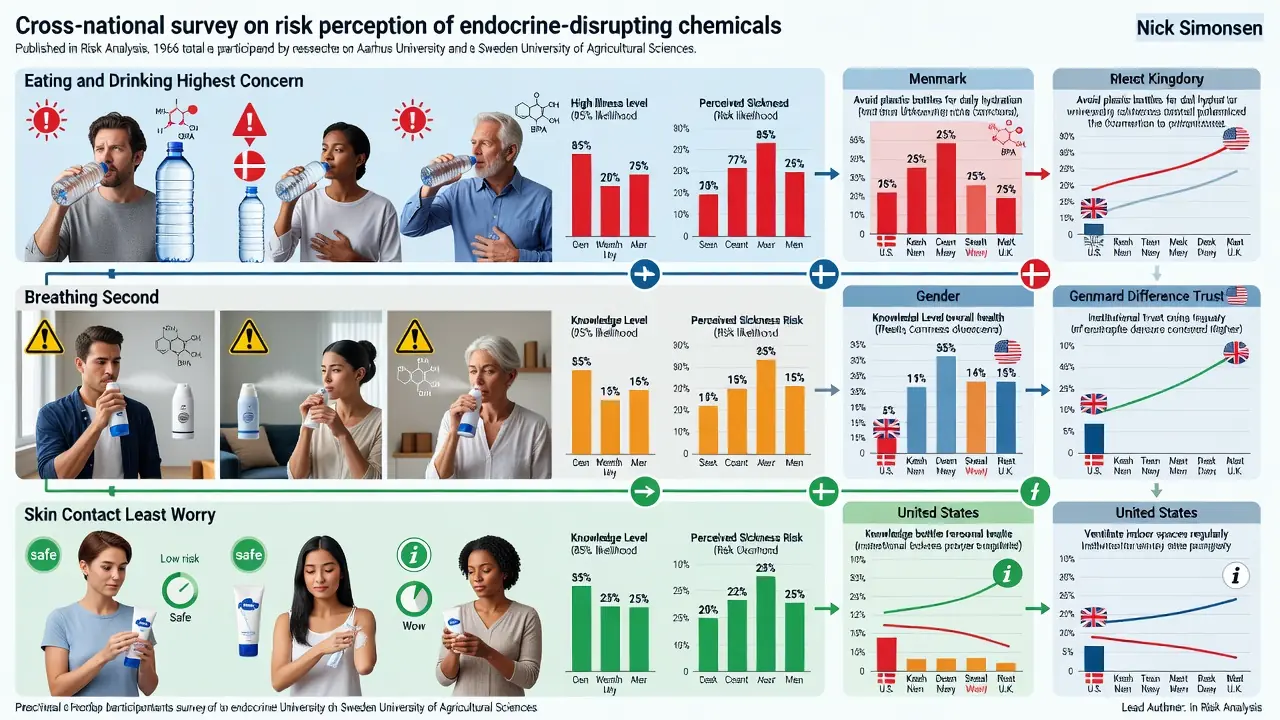
A new cross-national survey finds that people judge the danger of endocrine-disrupting chemicals (EDCs) mainly by how those chemicals enter the body, not by which chemical is involved. Published in Risk Analysis, the study of nearly 2,000 adults in Denmark, the United Kingdom and the United States shows that eating and drinking trigger the most concern, breathing comes second, and skin contact through personal care products worries people least.
How the study measured risk perception
Researchers from Aarhus University and the Swedish University of Agricultural Sciences surveyed 657 adults each in Denmark and the U.K. and 652 in the U.S., for a total of 1,966 participants. Respondents evaluated 18 everyday scenarios - drinking from BPA-containing plastic bottles, applying paraben-based sunscreen, or breathing phthalates released by indoor air fresheners - and rated each on dread, controllability, how well science understands the risk, and perceived likelihood of illness. The scenarios grouped together by exposure route rather than by the specific chemical involved, suggesting people reason about pathways into the body more than about the substances themselves.
Knowledge didn't bring reassurance
One of the study's more counterintuitive findings is that participants who reported knowing more about EDCs also rated themselves as more likely to get sick from them. That pattern held across all three countries, challenging the common assumption that more information automatically calms public concern. Women in the U.S. and U.K. perceived greater personal risk and higher overall health risk than men did, though other demographic effects varied by country and were not consistent across the sample.
Trust and emotion worked differently by country
Institutional trust did not have a uniform effect. In the U.S. and U.K., people who trusted institutions more actually rated their likelihood of illness from EDCs as higher, while in Denmark greater trust correlated with lower perceived overall risk. The researchers also found that American and British respondents leaned more heavily on emotional factors such as dread and catastrophic potential, whereas Danish respondents weighted deliberative factors like knowledge and controllability more strongly.
Practical implications for public health messaging
Lead author Nick Simonsen of Aarhus University suggested that health agencies should frame guidance around everyday activities - eating, drinking, breathing indoor air, using personal care products - rather than around individual chemical names, since that mirrors how people actually process the risk. The authors recommend tailoring outreach to an audience's existing knowledge and trust levels instead of relying on broad demographic categories, and adapting international campaigns to reflect national differences in reasoning style.
The authors caution that the survey captured a single moment in time, relied entirely on self-reported attitudes, and cannot establish cause and effect. Participants were given a brief introduction to EDCs before answering, and the study did not measure actual behavior or real-world chemical exposure.