
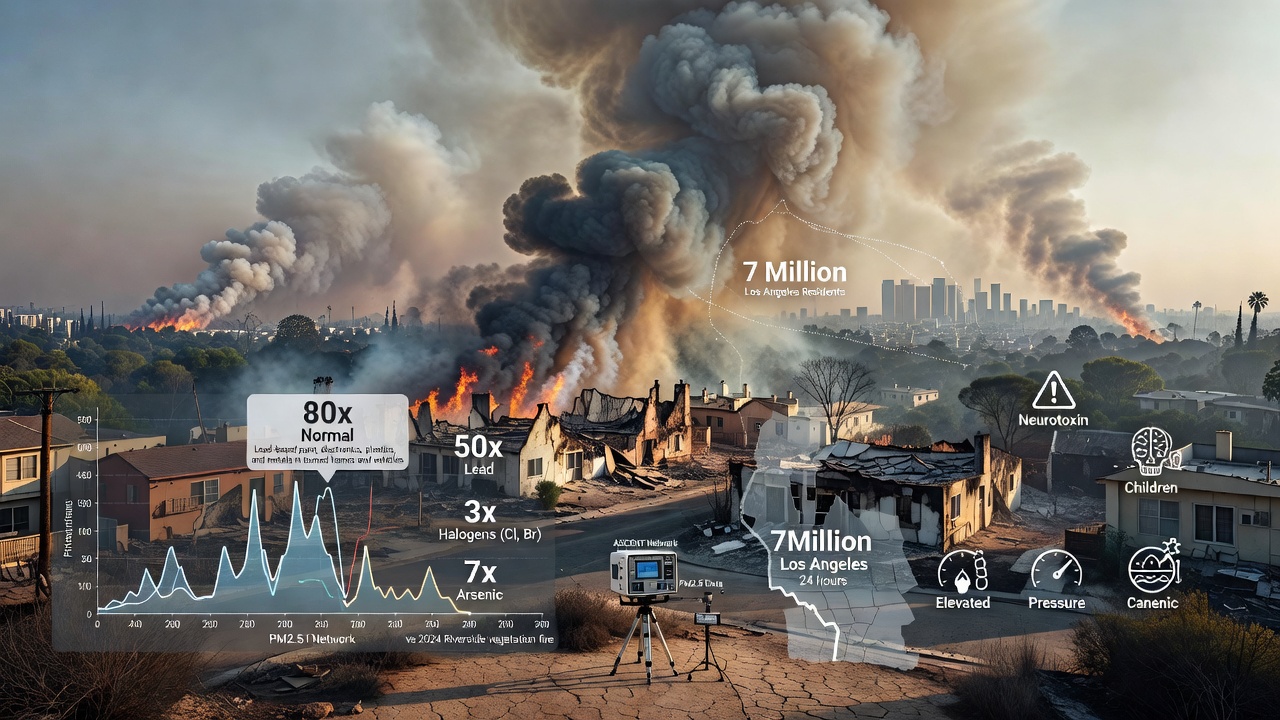
New research from the California Institute of Technology shows that smoke from the January 2025 Eaton Fire exposed roughly 7 million people in the Los Angeles area to lead concentrations more than 80 times above typical background levels during a single 24-hour stretch. The study, published in the journal Science Advances, offers the first detailed chemical comparison between smoke from a fire that tore through an urban area and smoke from a conventional wildland blaze.
Why burning cities produce different smoke than burning forests
The research team, led by Caltech atmospheric chemist Nga Lee "Sally" Ng, compared particulate data from the Eaton Fire with smoke from a 2024 vegetation fire in Riverside County. The difference was stark: the urban plume carried 50 times more lead, three times more arsenic and seven times more halogens such as chlorine and bromine than the wildland fire smoke. Those elements trace back to the materials inside homes and vehicles - lead-based paint, electronics, plastics and metal components - that burned when more than 16,000 structures were destroyed across Altadena and the Pacific Palisades.
"The main, key finding is really that wildfire smoke is very different fundamentally from the urban smoke," Ng said. Co-author Haroula Baliaka said the work helps close a research gap, since most wildfire health studies have focused on vegetation fires rather than fires that consume entire neighborhoods.
A new monitoring network made hour-by-hour data possible
The findings relied on the Atmospheric Science and Chemistry mEasurement NeTwork, or ASCENT, a relatively new system of air-quality monitors that measures the size and chemical makeup of fine particulate matter, known as PM2.5, in real time. Ng said it is the first U.S. network capable of tracking the chemical composition of airborne particles as conditions change hour by hour, rather than through periodic sampling.
Ed Avol, professor emeritus at the University of Southern California's Keck School of Medicine, who was not involved in the study, said that level of detail is rare. "Typically we make measurements of airborne particulates and so forth a couple of times a week, at best," he said, calling the granular, hour-by-hour data one of the study's main advantages.
Health risks and unanswered questions
Lead is a well-documented neurotoxin linked to developmental harm in children, lower IQ scores and elevated blood pressure in adults, though researchers say the health effects of a short but intense spike in exposure, like the one measured during the Eaton Fire, remain poorly understood. Arsenic exposure is separately associated with increased cancer risk. Yaguang Wei, an environmental medicine researcher at the Icahn School of Medicine at Mount Sinai who was not involved in the study, said the results align with earlier work showing that wildfire-related PM2.5 tends to be more toxic than particulate pollution from other sources.
Implications for monitoring and emergency response
Both Wei and Avol said the findings carry practical implications as wildfires increasingly reach dense, built-up areas - a trend scientists tie partly to drier, warmer conditions linked to climate change. Wei said expanding monitoring networks, improving public alerts and increasing prescribed burns could help reduce future exposure. Avol described the intersection of wildland and urban fire as a "strange and increasingly dangerous new world" that will require new thinking about how to limit public exposure to the metals and chemicals embedded in everyday building materials, since those materials are not going away.