
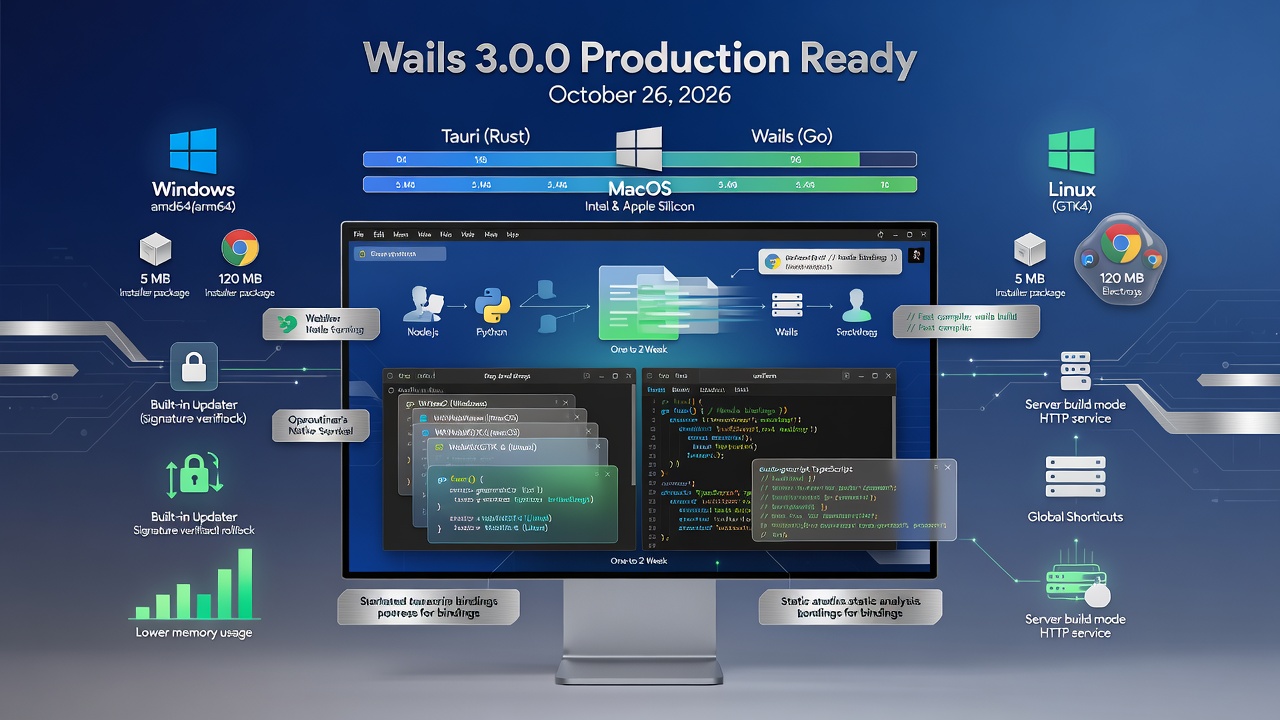
After nearly four years of development, Wails has shipped version 3.0.0 on October 26, 2026, moving the framework out of alpha and beta status into a release considered stable enough for production use. The milestone matters because it gives developers who build desktop apps with a Go backend and a web-technology frontend a mature, full-featured alternative to Electron and Rust-based Tauri.
How Wails avoids Electron's weight
Electron ships an entire Chromium browser and Node.js runtime with every application, which guarantees a consistent environment but inflates installer size to roughly 80-150MB even for a minimal app. Wails takes a different route: it calls the operating system's own WebView component-WebView2 on Windows, WKWebView on macOS, WebKitGTK on Linux-and pairs it with a Go backend. The frontend and backend communicate through automatically generated bindings. This mirrors Tauri's architecture, with the main distinction being Go instead of Rust on the backend. The practical payoff is installers measured in single-digit megabytes and noticeably lower memory use, since the app isn't carrying its own browser.
Why Go lowers the entry barrier
Compared with Tauri, Wails' chief selling point is accessibility. Rust rewards developers with strong performance and safety guarantees and a deep plugin ecosystem, but its ownership model, lifetimes, and async patterns take real time to master. Go's simpler syntax, fast compilation, and goroutine-based concurrency mean developers coming from Node.js or Python can typically produce a working backend within one to two weeks, according to the project's own framing. Teams that already maintain Go services or internal libraries can fold that code directly into a desktop app, since the framework's job is limited to binding existing Go logic to a window.
A ground-up rebuild, not an incremental update
The Wails team describes the move from v2 to v3 as a genuine migration rather than a routine upgrade. Apps, windows, services, and events are now explicit objects; multi-window support and system tray integration are built-in rather than community add-ons. Backend services are statically analyzed to auto-generate TypeScript bindings, preserving doc comments and parameter names while mapping Go structs and enums to their TypeScript equivalents. Native menus, dialogs, notifications, global shortcuts, and file drag-and-drop-including real file paths passed directly to Go for processing-are now built-in features, useful for workflows involving large file transfers. A built-in updater supports pluggable update sources, signature verification, and rollback, and the build system has shifted to a readable Taskfile-based workflow with official packaging support for Windows, macOS, and Linux formats.
Platform coverage and early validation
Stable support in v3.0.0 covers Windows (amd64/arm64), macOS (Intel and Apple Silicon), and Linux (amd64/arm64, defaulting to GTK4 and WebKitGTK 6.0). Mobile support for iOS and Android exists but remains explicitly experimental and outside the stable compatibility commitment. A Server build mode lets the same application run as an HTTP service. The development environment requires Go 1.26 or later. The open-source terminal client uniTerm adopted the Wails v3 beta in August 2026 and reportedly handled demanding workloads-high-volume terminal output streaming, multiple windows, tray integration, and file transfers-without needing workarounds outside the framework, and its team says the same codebase ran on iOS and Android with minimal changes.
Practical guidance for teams evaluating a switch
For organizations with existing Rust expertise seeking maximum performance and the broadest plugin ecosystem, Tauri likely remains the stronger choice. Teams built around Go, or sitting on a substantial base of Go business logic, may find Wails' migration costs more favorable. The Wails team cautions against migrating production projects immediately: v2 and v3 use separate CLIs and module paths, can run side by side on the same machine, and v2 will continue receiving critical updates, giving teams room to validate v3 on a separate branch before committing.