
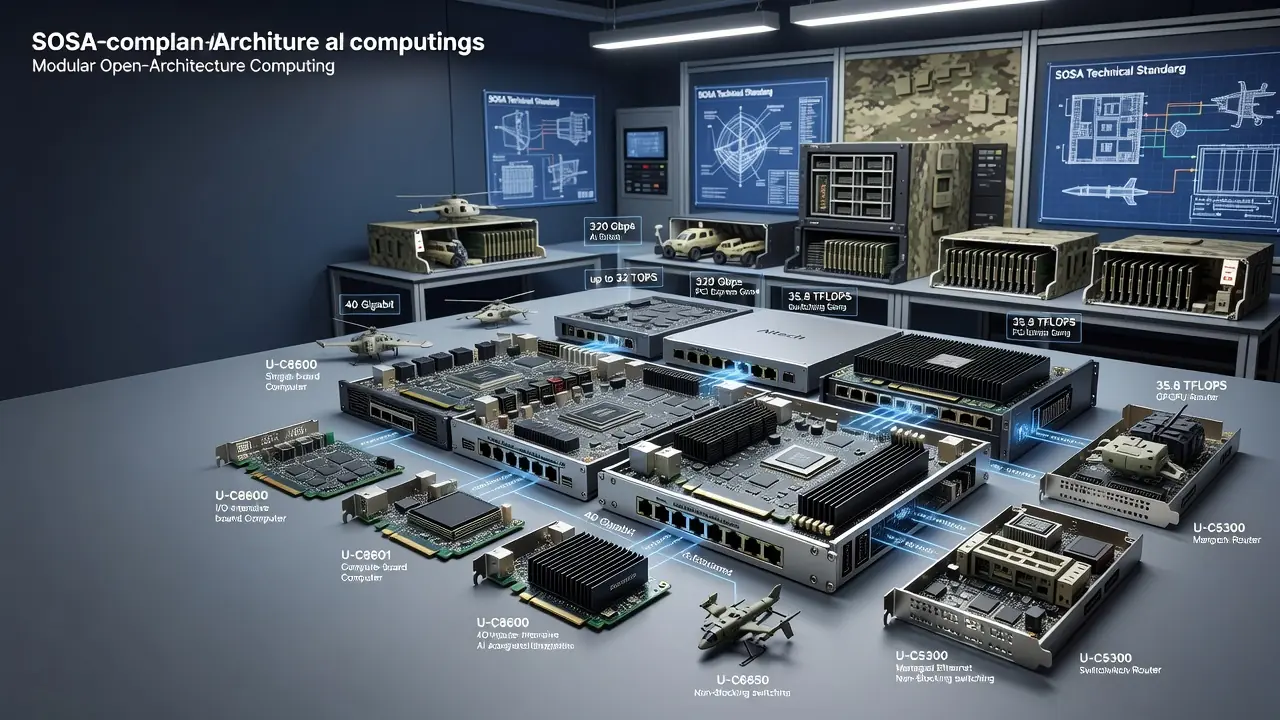
Aitech, based in Chatsworth, California, has introduced a four-card hardware lineup built to the Sensor Open Systems Architecture (SOSA) Technical Standard. The suite combines mission computing, AI acceleration, and high-speed networking into a modular package intended for open-architecture military systems.
What the Suite Includes
The Aitech SOSA Suite comprises four cards: the U-C8600, an I/O-intensive single-board computer; the U-C8601, a compute-intensive single-board computer; the U-C6850, a managed Ethernet switch/router; and the U-C5300, a general-purpose graphics processing unit (GPGPU) board. According to the company, these boards can function independently or be combined, communicating over a shared 40 Gigabit Ethernet and PCI Express Gen4 backbone.
Processing and Networking Specifications
Aitech states that the U-C8601 delivers up to 32 TOPS (trillion operations per second) of integrated AI acceleration, while the U-C5300 GPGPU board supplies up to 35.8 TFLOPS for tasks such as AI inference, image processing, sensor fusion, and video analytics. The U-C6850 switch/router is rated for as much as 320 Gbps of non-blocking Layer 2/Layer 3 switching, with configuration options supporting up to eight 40 Gigabit Ethernet interfaces or 32 10 Gigabit Ethernet interfaces.
Why SOSA Compliance Matters
SOSA is an industry and defense-sector standard designed to ensure that hardware modules from different vendors can interoperate within a common electronic architecture. By aligning its suite with this standard, Aitech is positioning the cards for use across a range of platforms without requiring custom integration work for each one. The company says the modular design supports deployment in aircraft, ground vehicles, missiles, helicopters, and uncrewed systems, allowing program integrators to mix and match compute, networking, and acceleration components based on mission requirements rather than being locked into a single fixed configuration.
Practical Considerations
Because the suite relies on a shared 40 Gigabit Ethernet and PCI Express Gen4 architecture, bandwidth and latency performance in real deployments will depend on how many cards are combined and how data flows between them. The figures Aitech provides-TOPS, TFLOPS, and Gbps ratings-reflect manufacturer specifications rather than independent, third-party performance testing. Defense integrators evaluating the suite would typically need to validate throughput and thermal performance under their specific platform conditions before fielding the hardware.